MIT News: Four from MIT named 2017 Arnold O. Beckman Postdoctoral Fellows

MIT News: Four from MIT named 2017 Arnold O. Beckman Postdoctoral Fellows

MIT News – Melanie Miller Kaufman – Department of Chemical Engineering – April 24, 2017

Chemical engineering and chemistry postdocs “expected to become the next generation of leaders and innovators in science, engineering, and technology.”

Danielle Mai and Freddy Nguyen from the MIT Department of Chemical Engineering, along with Liela Bayeh and Julianne Troiano of the Department of Chemistry, were awarded 2017 Arnold O. Beckman Postdoctoral Fellowships. The two-year, competitive program will support each researcher’s continuing work in their corresponding labs.

Freddy Nguyen, a member of the Michael Strano lab, is working to develop nanoscale molecular sensors for probing cancer tumors and their microenvironments. He would like to implant nanosensors inside tumors to measure their response, at the molecular level, to various cancer therapies such as chemotherapeutics and radiation therapy. In 2016, he earned his medical degree from the University of Illinois at Chicago, and in 2015 received a PhD in physical chemistry from the University of Illinois at Urbana-Champaign.

2017 Arnold O. Beckman Postdoctoral Fellow

2017 Arnold O. Beckman Postdoctoral Fellow

Arnold and Mabel Beckman Foundation – March 30, 2017

2017 Beckman Postdoctoral Fellow
Massachusetts Institute of Technology
Research: Development of nanosensors for in-vivo monitoring of cancer therapeutics

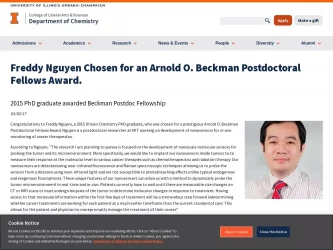
Freddy Nguyen Chosen for an Arnold O. Beckman Postdoctoral Fellows Award

Freddy Nguyen Chosen for an Arnold O. Beckman Postdoctoral Fellows Award

2015 PhD graduate awarded Beckman Postdoc Fellowship – March 30, 2017

Congratulations to Freddy Nguyen, a 2015 Illinois Chemistry PhD graduate, who was chosen for a prestigious Arnold O. Beckman Postdoctoral Fellows Award. Nguyen is a postdoctoral researcher at MIT working on development of nanosensors for in vivomonitoring of cancer therapeutics.

According to Nguyen, “The research I am planning to pursue is focused on the development of nanoscale molecular sensors for probing the tumor and its microenvironment. More specifically, we would like to implant our nanosensors inside tumors to to measure their response at the molecular level to various cancer therapies such as chemotherapeutics and radiation therapy. Our nanosensors are detected using near-infrared fluorescence and Raman spectroscopic techniques allowing us to probe the sensors from a distance using near-infrared light and are not susceptible to photobleaching effects unlike typical endogenous and exogenous fluorophores. These unique features of our nanosensors can allow us with a method to dynamically probe the tumor microenvironment in real-time and in-vivo. Patients currently have to wait until there are measurable size changes on CT or MRI scans or must undergo biopsies of the tumor to determine molecular changes in response to treatment. Having access to that molecularinformation within the first few days of treatment will be a tremendous step forward indetermining whether cancer treatments are working for each patient at a much earlier timeframe than the current standard of care. This allows for the patient and physician to morepromptly manage the treatment of their cancer.”

Investigating Effects of Proteasome Inhibitor on Multiple Myeloma Cells Using Confocal Raman Microscopy

Investigating Effects of Proteasome Inhibitor on Multiple Myeloma Cells Using Confocal Raman Microscopy

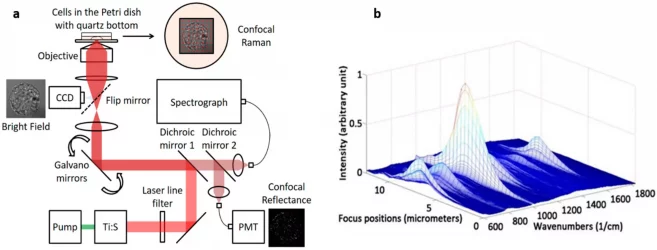
Due to its label-free and non-destructive nature, applications of Raman spectroscopic imaging in monitoring therapeutic responses at the cellular level are growing. We have recently developed a high-speed confocal Raman microscopy system to image living biological specimens with high spatial resolution and sensitivity. In the present study, we have applied this system to monitor the effects of Bortezomib, a proteasome inhibitor drug, on multiple myeloma cells. Cluster imaging followed by spectral profiling suggest major differences in the nuclear and cytoplasmic contents of cells due to drug treatment that can be monitored with Raman spectroscopy. Spectra were also acquired from group of cells and feasibility of discrimination among treated and untreated cells using principal component analysis (PCA) was accessed. Findings support the feasibility of Raman technologies as an alternate, novel method for monitoring live cell dynamics with minimal external perturbation.

High resolution live cell Raman imaging using subcellular organelle-targeting SERS-sensitive gold nanoparticles with highly narrow intra-nanogap

High resolution live cell Raman imaging using subcellular organelle-targeting SERS-sensitive gold nanoparticles with highly narrow intra-nanogap

We report a method to achieve high speed and high resolution live cell Raman images using small spherical gold nanoparticles with highly narrow intra-nanogap structures responding to NIR excitation (785 nm) and high-speed confocal Raman microscopy. The three different Raman-active molecules placed in the narrow intra-nanogap showed a strong and uniform Raman intensity in solution even under transient exposure time (10 ms) and low input power of incident laser (200 μW), which lead to obtain high-resolution single cell image within 30 s without inducing significant cell damage. The high resolution Raman image showed the distributions of gold nanoparticles for their targeted sites such as cytoplasm, mitochondria, or nucleus. The high speed Raman-based live cell imaging allowed us to monitor rapidly changing cell morphologies during cell death induced by the addition of highly toxic KCN solution to cells. These results strongly suggest that the use of SERS-active nanoparticle can greatly improve the current temporal resolution and image quality of Raman-based cell images enough to obtain the detailed cell dynamics and/or the responses of cells to potential drug molecules.

Measuring uptake dynamics of multiple identifiable carbon nanotube species via high-speed confocal Raman imaging of live cells

Measuring uptake dynamics of multiple identifiable carbon nanotube species via high-speed confocal Raman imaging of live cells

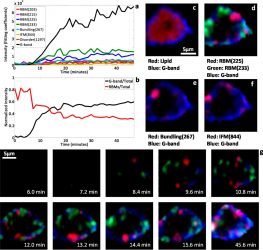
Carbon nanotube uptake was measured via high-speed confocal Raman imaging in live cells. Spatial and temporal tracking of two cell-intrinsic and nine nanotube-derived Raman bands was conducted simultaneously in RAW 264.7 macrophages. Movies resolved single (n, m) species, defects, and aggregation states of nanotubes transiently as well as the cell position, denoted by lipid and protein signals. This work portends the real-time molecular imaging of live cells and tissues using Raman spectroscopy, affording multiplexing and complete photostability.

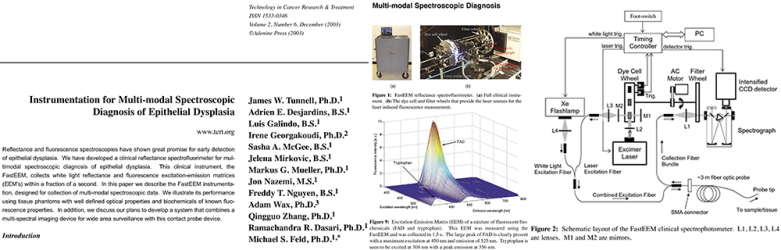
Instrumentation for multi-modal spectroscopic diagnosis of epithelial dysplasia

Instrumentation for multi-modal spectroscopic diagnosis of epithelial dysplasia

Reflectance and fluorescence spectroscopies have shown great promise for early detection of epithelial dysplasia. We have developed a clinical reflectance spectrofluorimeter for multimodal spectroscopic diagnosis of epithelial dysplasia. This clinical instrument, the FastEEM, collects white light reflectance and fluorescence excitation-emission matrices (EEM’s) within a fraction of a second. In this paper we describe the FastEEM instrumentation, designed for collection of multi-modal spectroscopic data. We illustrate its performance using tissue phantoms with well defined optical properties and biochemicals of known fluorescence properties. In addition, we discuss our plans to develop a system that combines a multi-spectral imaging device for wide area surveillance with this contact probe device.